
SeaBee scales up with LUMI
Trygve Heide | March 18th, 2026 | Seabird Monitoring
SeaBee partners with Europe’s most powerful computer to crack its data bottleneck
SeaBee has engaged with the LUMI AI Factory as one of its first ever real-life data streaming pilot projects. It is a significant milestone for SeaBee, and a sign of how seriously the challenge of large-scale environmental monitoring is being taken at a European level. The partnership addresses a problem that has been building for some time.
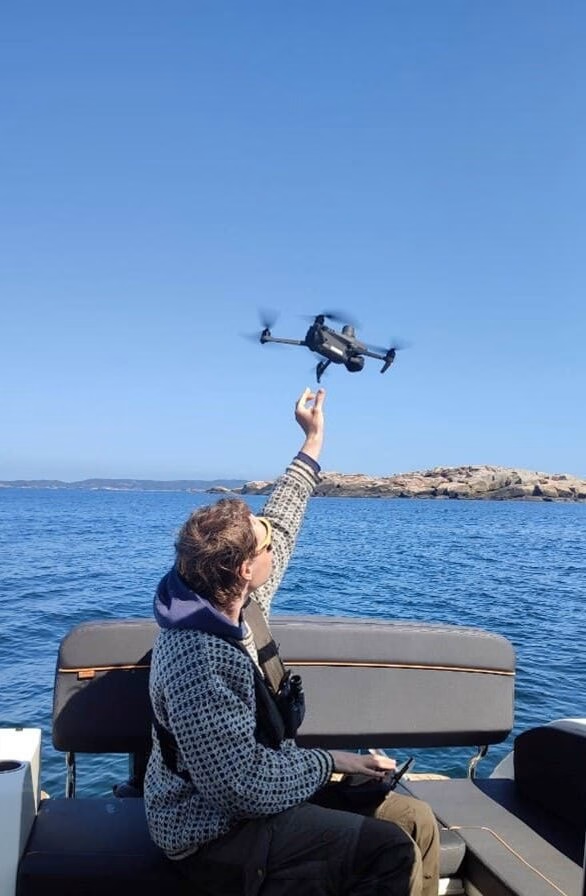
Deployment of a Mavic 3 Multispectral from a boat near a seabird colony. Photo: Marie Curtet
As drone technology improves, the challenges on processing capacity is only growing bigger. Sensors are sharper, flights cover more ground, and every upgrade means more data arriving faster than the pipeline can handle it. Every year, expert survey teams fan out along Norway’s coastline for the annual seabird population census, led by NINA. Drones fly, data piles up, and back on the server, the queue starts growing. Data processing that ideally should take hours can take days or weeks. By the time the analysis is ready, the field teams are long gone.
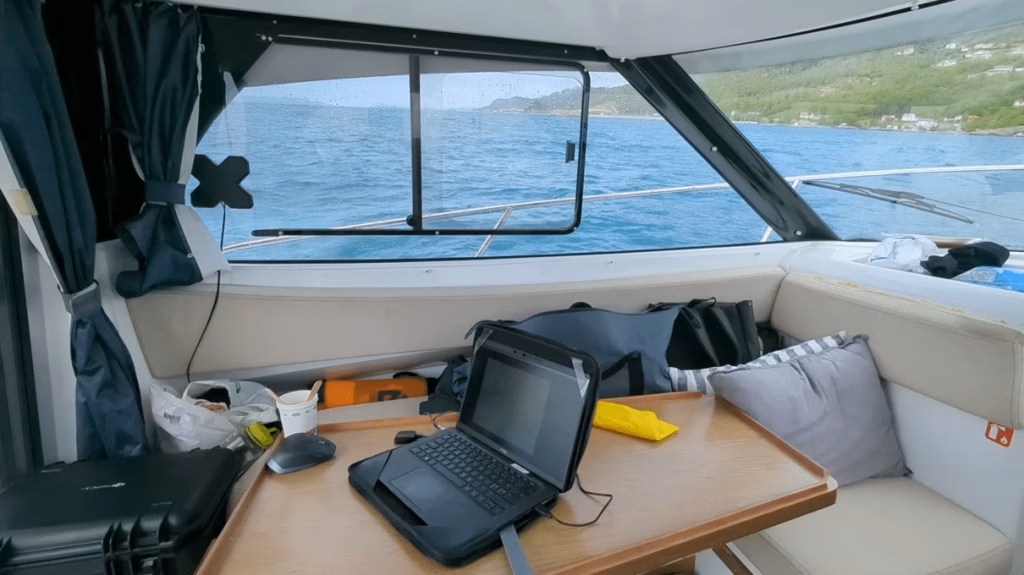
Ready for reviewing drone data collected during the day, before uploading to the SeaBee Data Pipeline
Built for scale
SeaBee’s data platform runs on NIRD, the Norwegian National Infrastructure for Research Data, managed by Sigma2. It provides the reliable storage and data management backbone that underpins SeaBee’s day-to-day operations, and Sigma2 is a key partner in everything we do. But during peak survey periods, when tens of terabytes of drone imagery arrive within days, even the most robust national infrastructure faces limits. The bottleneck is GPU capacity, the specialised computing power that drives AI and machine learning. Demand during the census season simply outstrips what any single national platform is designed to provide.
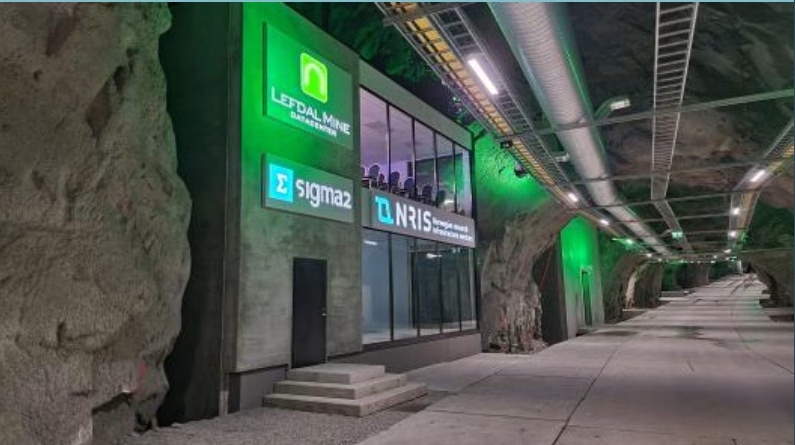
Lefdal Mine Data Centers, 60 meters below ground, 700 meters inside a mountain.
What LUMI brings to the table
LUMI is one of the most powerful supercomputers in the world, housed in a former paper mill in Kajaani, Finland, and funded as a shared European research infrastructure. The LUMI AI Factory is built around it, offering researchers access to enormous computing power alongside the technical expertise to put it to use.

LUMI AI Factory Promotional Photo. Photo by: LUMI AI Factory
The vision is a hybrid architecture that draws on the strengths of both systems. NIRD continues to handle what it does best: storage, data management, and initial image processing. As soon as a processed image is ready, it streams across to LUMI, where GPU nodes classify habitats and count birds in parallel at a scale that goes beyond what national platforms are built for. Results come straight back and are published through SeaBee’s mapping platform, available to ecologists in near real time.
“Our existing pipelines on NIRD work well, but data volumes are becoming challenging. It is exciting to have the opportunity to scale our AI processing onto the LUMI supercomputer,” says James Sample, Senior Engineer on the SeaBee team.

Photograph of James Sample, Senior Engineer for SeaBee/NIVA. Photo: Trygve Heide/NIVA
Done well, turnaround times could drop from days to hours, allowing field teams to check results, spot gaps in coverage, and adapt before heading home.
What comes next
The teams at SeaBee, Sigma2, CSC, and NINA are still in the early stages, but the longer-term possibilities are already coming into view: automated drone stations collecting data continuously, and AI models running directly on raw imagery without the slow stitching step that currently fails over open water.
Norway’s coastline is long, complex, and under increasing pressure. This pilot is a meaningful step towards monitoring it at the scale it deserves.
Read about the collaboration from LUMI AI Factory’s perspective at lumi-supercomputer.eu/seabee.